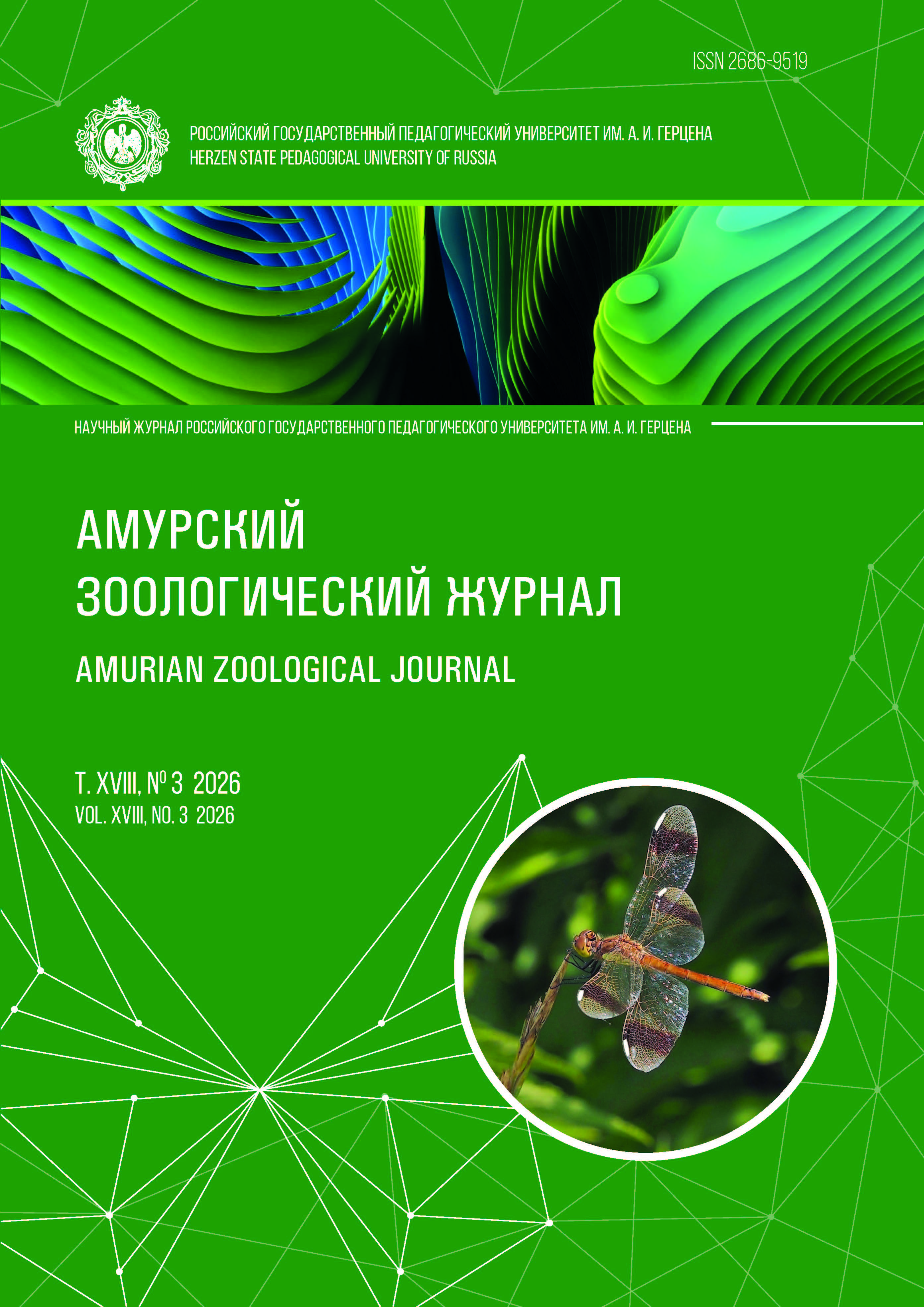
Первая находка яиц новой для территории России расы глухой кукушки Cuculus optatus на юге острова Сахалин
DOI:
https://doi.org/10.33910/2686-9519-2026-18-3-826-837Ключевые слова:
глухая кукушка, бамбуковая широкохвостка, Horornis diphone, корольковая пеночка, генетические расы, остров СахалинАннотация
В июне 2023 г. на юге острова Сахалин найдено и описано три яйца глухой кукушки кирпичной окраски, подброшенные в гнезда бамбуковых широкохвосток и корольковой пеночки. Установлена их принадлежность к японской расе horornis, ранее не регистрировавшейся на территории России. Как и на острове Хоккайдо, в условиях Сахалина, основным хозяином расы является бамбуковая широкохвостка. Судя по заражённости, 2 случая из 10 гнёзд (20 %), данная раса кукушки в настоящее время на исследованной территории сравнительно обычна. Пока невозможно ничего сказать о биологической совместимости видов, так как по имеющимся данным, доля принятия яйца кукушки у широкохвостки составила 50 %.
Библиографические ссылки
Литература
Балацкий, Н. Н. (1991a) Глухая кукушка и ее воспитатели в заповеднике Кедровая Падь и его окрестностях. Uragus. Сибирский орнитологический журнал, № 1, с. 4–11.
Балацкий, Н. Н. (1991b) Глухая кукушка и теньковка в Новосибирской области. Биологические науки, № 5, с. 56–62.
Балацкий, Н. Н. (1998) Ооморфологические характеристики глухой кукушки Cuculus saturatus в Северной Азии. В кн.: Актуальные проблемы оологии: материалы II Международной конференции стран СНГ. Липецк: Изд-во Липецкого государственного педагогического института, с. 21–22.
Балацкий, Н. Н., Бачурин, Г. Н. (1999) Кукушки Западной Сибири и сопредельных территорий. Беркут, т. 8, № 2, с. 172–182.
Бачурин, Г. Н., Капитонова, Л. В. (2010) К размножению глухой кукушки (Versiculus horsfieldi) на о. Сахалин. В кн.: Е. Н. Курочкин, А. В. Давыгора (ред.). Орнитология в Северной Евразии: материалы XIII Международной орнитологической конференции Северной Евразии. Оренбург: Изд-во Оренбургского государственного педагогического университета, с. 55.
Бачурин, Г. Н., Капитонова, Л. В. (2014) Аспекты биологической совместимости глухой кукушки Cuculus (saturatus) optatus и ее видов-воспитателей на о. Сахалин. Дальневосточный орнитологический журнал, № 4, с. 42–56.
Виноградов, А. А., Романов, А. А., Бачурин, Г. Н. (2022) Регистрация кормления слётка глухой кукушки Cuculus optatus бамбуковой широкохвосткой Horornis diphone на острове Итуруп. Русский орнитологический журнал, т. 31, № 2252, с. 5199–5201.
Кисленко, Г. С., Наумов, P. Л. (1967) Паразитизм и экологические расы обыкновенной и глухой кукушек в азиатской части СССР. Орнитология, № 8, с. 79–97.
Мещерягина, С. Г. (2017) Расы Cuculus optatus Gould на территории России: особенности связей с видами-хозяевами. В кн.: Экология: факты, гипотезы, модели. Материалы конференции молодых ученых. Екатеринбург: Лисица, с. 72–86.
Мещерягина, С. Г., Бачурин, Г. Н., Бурский, О. В. (2017) Распространение рас глухой кукушки на территории России: обзор регистраций гнездового паразитизма по видам-хозяевам. Фауна Урала и Сибири, № 2, с. 139–163.
Мещерягина, С. Г., Головатин, М. Г., Бачурин, Г. Н. (2019) Внутривидовая дифференциация глухой кукушки (Cuculus optatus) в пределах ареала: связь с обилием видов-хозяев. Экология, № 1, с. 22–29. https://doi.org/10.1134/S0367059719010062
Нечаев, В. А. (1991) Птицы острова Сахалин. Владивосток: ДВО АН СССР, 748 с.
Нумеров, А. Д. (1993) Глухая кукушка. В кн.: В. Д. Ильичев, В. Е. Флинт (ред.). Птицы России и сопредельных регионов: рябкообразные, голубеобразные, кукушкообразные, совообразные. М.: Наука, с. 225–236.
Нумеров, А. Д. (2003) Межвидовой и внутривидовой гнездовой паразитизм у птиц. Воронеж: Изд-во Воронежского государственного университета, 517 с.
Романов, А. Л., Романова, А. И. (1959) Птичье яйцо. М.: Пищепромиздат, 620 с.
Чунихин, С. П. (1964) Об особенностях гнездового паразитизма глухой кукушки Cuculus saturatus. Зоологический журнал, т. 43, № 8, с. 1249–1250.
Chen, W. J., Lee, P. F., Lin, R. S. (2009) The first record of an Oriental Cuckoo (Cuculus saturatus) killing nestlings in a potential host’s nest. Endemic Species Research, vol. 11, no. 2, pp. 63–67.
Cramp, S. (1985) Cuculus saturates Oriental cuckoo. In: S. Cramp (ed.). Handbook of the birds of Europe, the Middle East and North Africa. The Birds of the Western Palearctic. Vol. 4. Terns to woodpeckers. Oxford: Oxford University Press, pp. 417–422.
Erritzøe, J., Mann, C. F., Brammer, F. P., Fuller, R. A. (2012) Oriental cuckoo Cuculus saturatus. In: Cuckoos of the world. London: Christopher Helm Publ., pp. 468–472.
Fossøy, F., Antonov, A., Moksnes, A. et al. (2011) Genetic differentiation among sympatric Cuckoo host races: Males matter. Proceedings of the Royal Society B: Biological Sciences, vol. 278, no. 1712, pp. 1639–1645. https://doi.org/10.1098/rspb.2010.2090
Gibbs, H. L., Sorenson, M. D., Marchetti, K. et al. (2000) Genetic evidence for female host-specific races of the common cuckoo. Nature, vol. 407, no. 6801, pp. 183–186. https://doi.org/10.1038/35025058
Higuchi, H. (1998) Host use and egg color of Japanese cuckoos. In: S. I. Rothstein, S. K. Robinson (eds.). Parasitic birds and their hosts: Studies in coevolution. New York: Oxford University Press, pp. 80–93.
Higuchi, H., Sato, S. (1984) An example of character release in host selection and egg colour of Cuculus spp. in Japan. Ibis, vol. 126, no. 3, pp. 398–404. https://doi.org/10.1111/j.1474-919X.1984.tb00261.x
Hoyt, D. F. (1979) Practical methods of estimating volume and fresh weight of bird eggs. The Auk, vol. 96, no. 1, pp. 73–77.
Kamioki, M., Kawaji, N., Kawaji, K., Ueda, K. (2011) A predation attempt by an Oriental Cuckoo Cuculus optatus on Asian Stubtail Urosphena squameiceps nestlings. Forktail, no. 27, pp. 93–95.
Kawaji, N. (2009) An example of a reddish Oriental Cuckoo Cuculus saturates egg in a Japanese White-eye’s Zosterops japonicus nest. Japanese Journal of Ornithology, vol. 58, no. 1, pp. 98–102. https://doi.org/10.3838/jjo.58.98
Kawaji, N., Kamioki, M., Kawaji, K. (2023) Breeding ecology of Eastern Crowned Leaf Warbler and brood parasitism by the Oriental Cuckoo. Japanese Journal of Ornithology, vol. 72, no. 2, pp. 181–194. https://doi.org/10.3838/jjo.72.181
Kawaji, N., Kawaji, K. (2015) The first record of Reddish-brown egg parasitism by the Oriental Cuckoo Cuculus optatus upon the Black-faced Bunting Emberiza spodocephala in Western Hokkaido. Journal of the Yamashina Institute for Ornithology, vol. 46, no. 2, pp. 119–126. https://doi.org/10.3312/jyio.46.119
Meshcheryagina, S. G., Mashanova, A., Bachurin, G. N. et al. (2018) Host species determines egg size in Oriental cuckoo. Journal of Zoology, vol. 306, no. 3, pp. 147–155.
Mori, S., Kondo, Yu., Higuchi, H. (2012) An Eastern Crowned Leaf Warbler Phylloscopus coronatus nest parasitized by an Oriental Cuckoo Cuculus saturatus with a reddish egg in Hokkaido, Japan. Ornithological Science, vol. 11, no. 2, pp. 109–112. https://doi.org/10.2326/osj.11.109
Payne, R. B. (1997) Family Cuculidae (cuckoos). In: J. del Hoyo, A. Elliott, J. Sargatal (eds.). Handbook of the birds of the world. Vol. 4. Sandgrouse to cuckoos. Barcelona: Lynx Edicions, pp. 508–607.
Payne, R. B. (2005) The cuckoos. Oxford: Oxford University Press, 644 p.
References
Bachurin, G. N., Kapitonova, L. V. (2010) On the breeding of the Oriental Cuckoo (Cuculus horsfieldi) on Sakhalin Island. In: E. N. Kurochkin, A. V. Davygora (eds.). Ornithology in Northern Eurasia: Materials of the XIII International ornithological conference of Northern Eurasia. Orenburg: Orenburg State Pedagogical University Publ., p. 55. (In Russian)
Bachurin, G. N., Kapitonova, L. V. (2014) Aspects of biological compatibility between the Oriental cuckoo Cuculus (saturatus) optatus and its host species on Sakhalin Island, Russia. Far East Journal of Ornithology, no. 4, pp. 42–56. (In Russian)
Balatsky, N. N. (1991a) The Oriental Cuckoo and its hosts in the Kedrovaya Pad Nature Reserve and its environs. Uragus. Sibirskij ornitologicheskij zhurnal, no. 1, pp. 4–11. (In Russian)
Balatsky, N. N. (1991b) The Oriental Cuckoo and the Chiffchaff in the Novosibirsk Region. Biological Sciences, no. 5, pp. 56–62. (In Russian)
Balatsky, N. N. (1998) Oomorphological characteristics of Himalayan Cuckoo (Cuculus saturatus) from the Northern part of Asia. In: Current problems of oology: The II International conference of the CIS countries. Lipetsk: Lipetsk State Pedagogical Institute Publ., pp. 21–22. (In Russian)
Balatsky, N. N., Bachurin, G. N. (1999) The Cuckoos of the West Siberia and adjoining areas. Berkut, vol. 8, no. 2, pp. 172–182. (In Russian)
Chen, W. J., Lee, P. F., Lin, R. S. (2009) The first record of an Oriental Cuckoo (Cuculus saturatus) killing nestlings in a potential host’s nest. Endemic Species Research, vol. 11, no. 2, pp. 63–67. (In English)
Chunikhin, S. P. (1964) On the features of breeding parasitism of the Oriental Cuckoo Cuculus saturatus. Zoologicheskij zhurnal, vol. 43, no. 8, pp. 1249–1250. (In Russian)
Cramp, S. (1985) Cuculus saturates Oriental cuckoo. In: S. Cramp (ed.). Handbook of the birds of Europe, the Middle East and North Africa. The Birds of the Western Palearctic. Vol. 4. Terns to woodpeckers. Oxford: Oxford University Press, pp. 417–422. (In English)
Erritzøe, J., Mann, C. F., Brammer, F. P., Fuller, R. A. (2012) Oriental cuckoo Cuculus saturatus. In: Cuckoos of the world. London: Christopher Helm Publ., pp. 468–472. (In English)
Fossøy, F., Antonov, A., Moksnes, A. et al. (2011) Genetic differentiation among sympatric Cuckoo host races: Males matter. Proceedings of the Royal Society B: Biological Sciences, vol. 278, no. 1712, pp. 1639–1645. https://doi.org/10.1098/rspb.2010.2090 (In English)
Gibbs, H. L., Sorenson, M. D., Marchetti, K. et al. (2000) Genetic evidence for female host-specific races of the common cuckoo. Nature, vol. 407, no. 6801, pp. 183–186. https://doi.org/10.1038/35025058 (In English)
Higuchi, H. (1998) Host use and egg color of Japanese cuckoos. In: S. I. Rothstein, S. K. Robinson (eds.). Parasitic birds and their hosts: Studies in coevolution. New York: Oxford University Press, pp. 80–93. (In English)
Higuchi, H., Sato, S. (1984) An example of character release in host selection and egg colour of Cuculus spp. in Japan. Ibis, vol. 126, no. 3, pp. 398–404. https://doi.org/10.1111/j.1474-919X.1984.tb00261.x (In English
Hoyt, D. F. (1979) Practical methods of estimating volume and fresh weight of bird eggs. The Auk, vol. 96, no. 1, pp. 73–77. (In English)
Kamioki, M., Kawaji, N., Kawaji, K., Ueda, K. (2011) A predation attempt by an Oriental Cuckoo Cuculus optatus on Asian Stubtail Urosphena squameiceps nestlings. Forktail, no. 27, pp. 93–95. (In English)
Kawaji, N. (2009) An example of a reddish Oriental Cuckoo Cuculus saturates egg in a Japanese White-eye’s Zosterops japonicus nest. Japanese Journal of Ornithology, vol. 58, no. 1, pp. 98–102. https://doi.org/10.3838/jjo.58.98 (In English)
Kawaji, N., Kamioki, M., Kawaji, K. (2023) Breeding ecology of Eastern Crowned Leaf Warbler and brood parasitism by the Oriental Cuckoo. Japanese Journal of Ornithology, vol. 72, no. 2, pp. 181–194. https://doi.org/10.3838/jjo.72.181 (In English)
Kawaji, N., Kawaji, K. (2015) The first record of Reddish-brown egg parasitism by the Oriental Cuckoo Cuculus optatus upon the Black-faced Bunting Emberiza spodocephala in Western Hokkaido. Journal of the Yamashina Institute for Ornithology, vol. 46, no. 2, pp. 119–126. https://doi.org/10.3312/jyio.46.119 (In English)
Kislenko, G. S., Naumov, P. L. (1967) Parasitism and ecological races of Common Cuckoo and Oriental Cuckoo in the Asian part of the USSR. Journal of Ornithology, no. 8, pp. 79–97. (In Russian)
Meshcheryagina, S. G. (2017) Gentes of Cuculus optatus Gould in Russia: Features of relationships with host species. In: Ecology: Facts, hypotheses, models. Proceedings of the conference of young scientists. Ekaterinburg: Lisitsa Publ., pp. 72–86. (In Russian)
Meshcheryagina, S. G., Bachurin, G. N., Burskiy, O. V. (2017) Distribution of the Oriental Cuckoo gentes in Russia: A review of brood parasitism records by the host species. Fauna of the Urals and Siberia, no. 2, pp. 139–163. (In Russian)
Meshcheryagina, S. G., Golovatin, M. G., Bachurin, G. N. (2019) Intraspecific differentiation of the Oriental Cuckoo (Cuculus optatus) within the range: Relationship with the abundance of host species. Ekologiya, no. 1, pp. 22–29. https://doi.org/10.1134/S0367059719010062 (In Russian)
Meshcheryagina, S. G., Mashanova, A., Bachurin, G. N. et al. (2018) Host species determines egg size in Oriental cuckoo. Journal of Zoology, vol. 306, no. 3, pp. 147–155. (In English)
Mori, S., Kondo, Yu., Higuchi, H. (2012) An Eastern Crowned Leaf Warbler Phylloscopus coronatus nest parasitized by an Oriental Cuckoo Cuculus saturatus with a reddish egg in Hokkaido, Japan. Ornithological Science, vol. 11, no. 2, pp. 109–112. https://doi.org/10.2326/osj.11.109 (In English)
Nechaev, V. A. (1991) Birds of Sakhalin Island. Vladivostok: Far Eastern Branch of the USSR Academy of Sciences Publ., 748 p. (In Russian)
Numerov, A. D. (1993) Oriental Cuckoo. In: V. D. Il’ichev, V. E. Flint (eds.). The birds of Russia and contiguons regions: Pterocliformes, Columbiformes, Cuculiformes, Strigiformes. Moscow: Nauka Publ., pp. 225–236. (In Russian)
Numerov, A. D. (2003) Interspecific and intraspecific brood parasitism in birds. Voronezh: Voronezh State University Publ., 517 p. (In Russian)
Payne, R. B. (1997) Family Cuculidae (cuckoos). In: J. del Hoyo, A. Elliott, J. Sargatal (eds.). Handbook of the birds of the world. Vol. 4. Sandgrouse to cuckoos. Barcelona: Lynx Edicions, pp. 508–607. (In English)
Payne, R. B. (2005) The cuckoos. Oxford: Oxford University Press, 644 p. (In English)
Romanoff, A. L., Romanoff, A. J. (1959) The avian egg. Moscow: Pishchepromizdat Publ., 620 p. (In Russian)
Vinogradov, A. A., Romanov, A. A., Bachurin, G. N. (2022) Registration of feeding of Oriental cuckoo Cuculus optatus fledgling by Japanese bush warbler Horornis diphone on Iturup. The Russian Journal of Ornithology, vol. 31, no. 2252, pp. 5199–5201. (In Russian)
Загрузки
Опубликован
Выпуск
Раздел
Лицензия
Copyright (c) 2026 Шохрин Валерий Павлинович, Тиунов Иван Михайлович, Сватко Татьяна Алексеевна

Это произведение доступно по лицензии Creative Commons «Attribution» («Атрибуция») 4.0 Всемирная.
Авторы предоставляют материалы на условиях публичной оферты и лицензии CC BY 4.0. Эта лицензия позволяет неограниченному кругу лиц копировать и распространять материал на любом носителе и в любом формате в любых целях, делать ремиксы, видоизменять, и создавать новое, опираясь на этот материал в любых целях, включая коммерческие.
Данная лицензия сохраняет за автором права на статью, но разрешает другим свободно распространять, использовать и адаптировать работу при обязательном условии указания авторства. Пользователи должны предоставить корректную ссылку на оригинальную публикацию в нашем журнале, указать имена авторов и отметить факт внесения изменений (если таковые были).
Авторские права сохраняются за авторами. Лицензия CC BY 4.0 не передает права третьим лицам, а лишь предоставляет пользователям заранее данное разрешение на использование при соблюдении условия атрибуции. Любое использование будет происходить на условиях этой лицензии. Право на номер журнала как составное произведение принадлежит издателю.