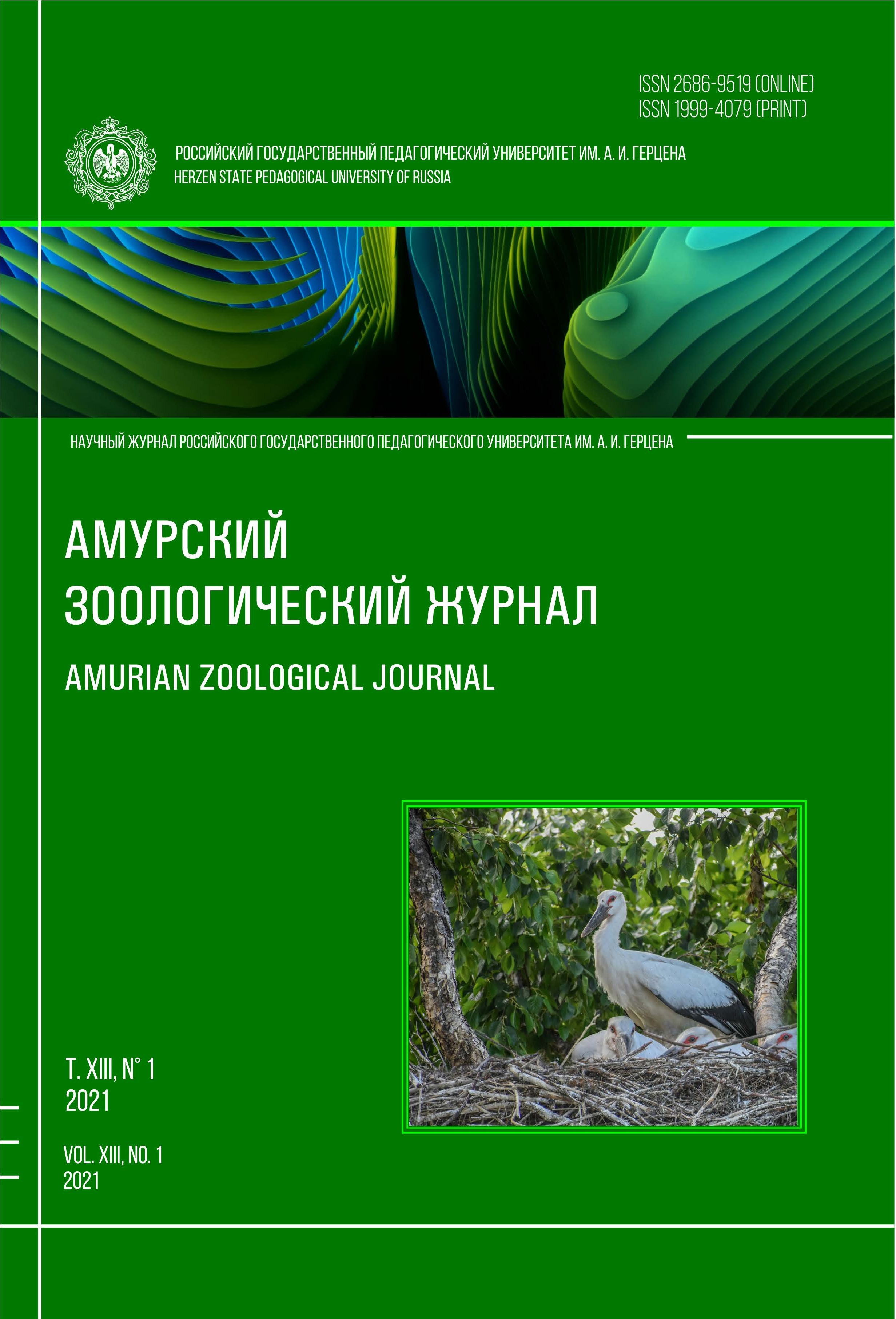
Oriental stork (Ciconia boyciana Swinhoe) breeding population survey in the Amur region in 2018–2019
DOI:
https://doi.org/10.33910/2686-9519-2021-13-1-89-104Keywords:
Oriental stork, Ciconia boyciana, breeding population, number of Storks, Amur regionAbstract
This article presents the Oriental stork population count in the Amur region of Russia, performed in 2018–2019. The data was collected during helicopter aerial surveys, ground surveys, using vehicles and drones and collecting questionnaires information. As a result, 404 nests were recorded, of which 324 nests were checked during the breeding season and were occupied, 62 nests were checked after the breeding season (in autumn or winter), but according to the set of external characteristics, they were identified as occupied nests, 18 nests were recorded from questionnaires information but have not been verified. In addition, 22 unoccupied nests are recorded. Half of all recorded nests are located in protected natural areas. 76% of all occupied nests are located on trees, 19% on power transmission poles, 5% on artificial nesting poles. The estimated number of breeding storks and chicks of the current year was 2010 individuals. 89.9% of breeding pairs successfully obtained offspring. The average brood size was 3.36 chicks (n = 143).
References
ЛИТЕРАТУРА
Сасин, А. А. (2013) Современное распространение дальневосточного аиста (Ciconia boyciana Swinhoe) в Амурской области. Амурский зоологический журнал, т. V, № 3, с. 353–357.
REFERENCES
Sasin, A. A. (2013) Sovremennoe rasprostranenie dal’nevostochnogo aista (Ciconia boyciana Swinhoe) v Amurskoj oblasti [Modern distribution of Oriental White Stork (Ciconia boyciana Swinhoe) in Amurskaya Oblast]. Amurskij zoologicheskij zhurnal — Amurian Zoological Journal, vol. V, no. 3, pp. 353–357.
Downloads
Published
Issue
Section
License
Copyright (c) 2021 Anton A. Sasin, Mikhail P. Parilov, Anna Yu. Serdyuk

This work is licensed under a Creative Commons Attribution-NonCommercial 4.0 International License.
The work is provided under the terms of the Public Offer and of Creative Commons public license Creative Commons Attribution 4.0 International (CC BY 4.0).
This license permits an unlimited number of users to copy and redistribute the material in any medium or format, and to remix, transform, and build upon the material for any purpose, including commercial use.
This license retains copyright for the authors but allows others to freely distribute, use, and adapt the work, on the mandatory condition that appropriate credit is given. Users must provide a correct link to the original publication in our journal, cite the authors' names, and indicate if any changes were made.
Copyright remains with the authors. The CC BY 4.0 license does not transfer rights to third parties but rather grants users prior permission for use, provided the attribution condition is met. Any use of the work will be governed by the terms of this license.