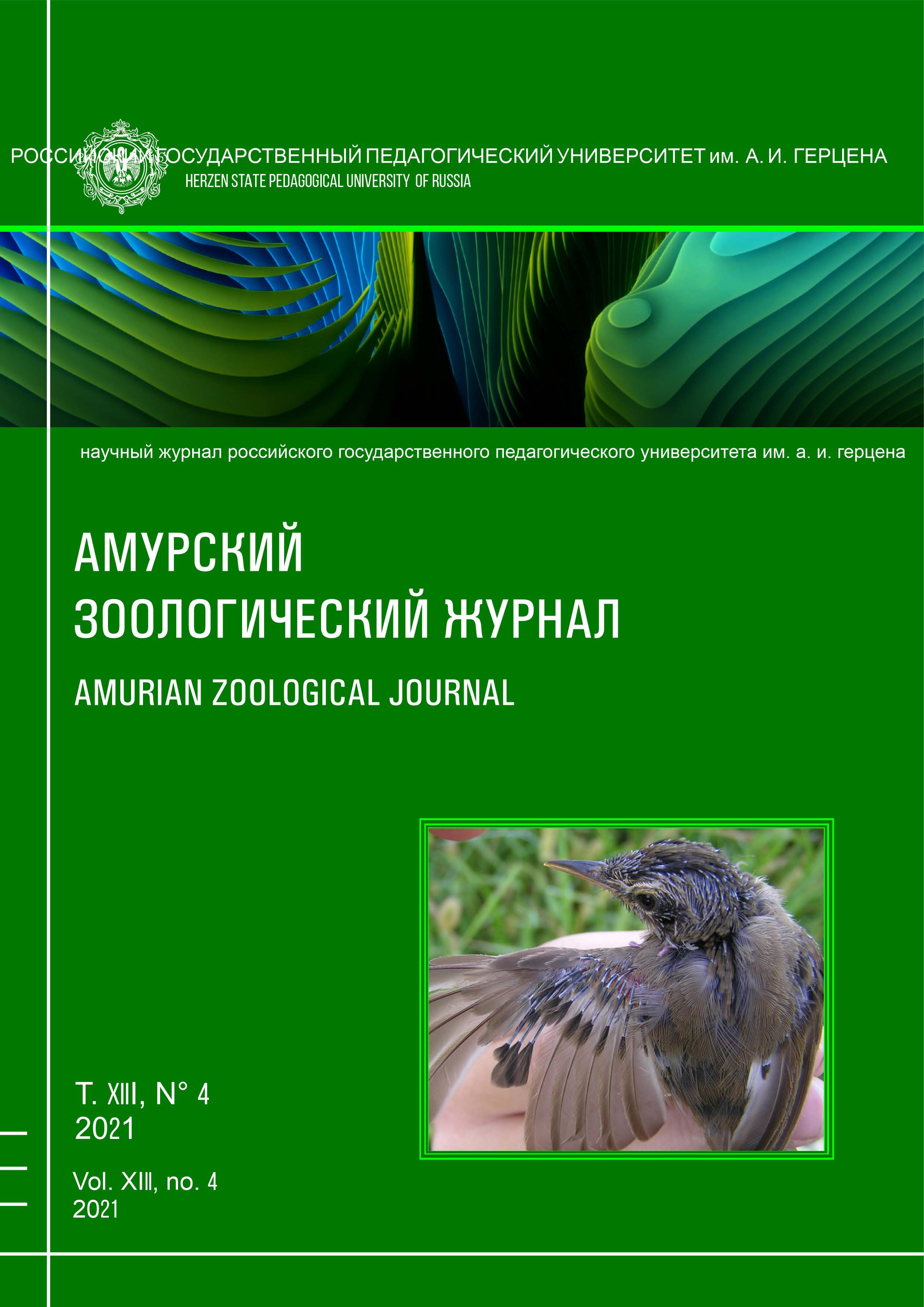
Bats in Sokhondinsky Nature Reserve
DOI:
https://doi.org/10.33910/2686-9519-2021-13-4-528-535Keywords:
Transbaikalia, fauna, sex ratio, bats, Sokhondinsky Nature ReserveAbstract
In 2019–2021 we captured bats in mist nets in the buffer zone of the Sokhondinsky Nature Reserve. Five species of bats were recorded: Myotis petax, M. sibiricus, Plecotus ognevi, Eptesicus nilssonii, Vespertilio murinus. Of these, M. petax, M. sibirica, V. murinus are reported for the first time in this area. Despite the non-selective method of catching bats, the sex ratio of the collected species is male-biased, and only E. nilssonii is female-biased. The predominance of males among the captured V. murinus is of interest since the Transbaikal area is considered to be the breeding zone of migratory bats.
References
ЛИТЕРАТУРА
Ботвинкин, А. Д. (2002) Летучие мыши в Прибайкалье (биология, методы наблюдения, охрана). Иркутск: Время странствий, 208 с.
Вишняков, Е. В., Тарабарко, А. Н., Кирилюк, В. Е. и др. (ред.). (2012) Красная книга Забайкальского края. Животные. Новосибирск: Новосибирский издательский дом, 344 с.
Крускоп, С. В. (2003) Находки рукокрылых в долине реки Шилки. Plecotus et al., № 6, с. 59–62.
Крускоп, С. В. (2012) Отряд Chiroptera. В кн.: И. Я. Павлинов, А. А. Лисовский (ред.). Млекопитающие России: систематико-географический справочник. М.: Товарищество научных изданий КМК, с. 73–126.
Летопись природы Сохондинского государственного природного биосферного заповедника. (1987) Кыра. (На правах рукописи).
Некипелов, Н. В. (1960) Распространение млекопитающих в Юго-Восточном Забайкалье и численность некоторых видов. В кн.: А. Н. Гранина, И. В. Домарадский, И. Ф. Жовтый и др. (ред.). Биологический сборник. Иркутск: ИГУ, c. 3–48.
Смирнов, Д. Г., Вехник, В. П. (2014) Соотношение полов и пространственная структура популяций оседлых видов рукокрылых (Chiroptera, Vespertilionidae) Среднего Поволжья. Зоологический журнал, т. 93, № 9, с. 1117–1127. https://doi.org/10.7868/S0044513414090104
Снитько, В. П. (2007) Сезонная пространственная дифференциация половых групп в популяциях оседлых видов рукокрылых (Chiroptera, Vespertilionidae) Южного Урала. Экология, № 5. c. 362–368.
Стрелков, П. П., Абрамов, А. В. (2001) Соотношение полов и возрастной состав самцов в разных частях ареала в сезон вывода потомства у перелетных видов летучих мышей (Chiroptera, Vespertilionidae) Восточной Европы и смежных территорий. Зоологический журнал, т. 80, № 2, с. 222–229.
Стрелков, П. П., Бунтова, Е. Г. (1982) Усатая ночница (Myotis mystacinus) и ночница Брандта (M. brandti) в СССР и взаимоотношение этих видов. Сообщение 1. Зоологический журнал, т. 51, № 8, с. 1227–1240.
Хританков, А. М., Путинцев, Н. И. (2004) Новые находки рукокрылых в Сибири. Plecotus et al., № 7, с. 72–76.
Bazhenov, Yu. A. (2021) Ecology of bat species in the arid region of the Daurian steppe at the peak of drought. Nature Conservation Research, vol. 6, no. 1, pp. 42–49. https://dx.doi.org/10.24189/ncr.2021.007
Kunz, T. H., Kurta, A. (1990) Capture methods and holding devices. In: T. H. Kunz (ed.). Ecological and behavioral methods for the study of bats. Washingon: Smithsonian Institution Press, pp. 1–29.
Matveev, V. A., Kruskop, S. V., Kramerov, D. A. (2005) Revalidation of Myotis petax Hollister, 1912 and its new status in connection with M. daubentonii (Kuhl, 1817) (Vespertilionidae, Chiroptera). Acta Chiropterologica, vol. 7, no. 1, pp. 23–37.
REFERENCES
Bazhenov, Yu. A. (2021) Ecology of bat species in the arid region of the Daurian steppe at the peak of drought. Nature Conservation Research, vol. 6, no. 1, pp. 42–49. https://dx.doi.org/10.24189/ncr.2021.007 (In English)
Botvinkin, A. D. (2002) Letuchiye myshi v Pribajkal’e (biologiya, metody nablyudeniya, okhrana) [Bats in Baikal region (biology, observation methods, conservation)]. Irkutsk: Vremya stranstvij Publ., 208 р. (In Russian)
Khritankov, A. M., Putintsev, N. I. (2004) Novye nakhodki rukokrylykh v Sibiri [New records of bats in Siberia]. Plecotus et al., no. 7, pp. 72–76. (In Russian)
Kruskop, S. V. (2003) Nakhodki rukokrylykh v doline reki Shilki [Records of bats in the Shilka River valley]. Plecotus et al., no. 6, pp. 59–62. (In Russian)
Kruskop, S. V. (2012) Otryad Chiroptera [Order Chiroptera]. In: I. Ya. Pavlinov, А. А. Lisovsky (eds.). Mlekopitayushchie Rossii: sistematiko-geograficheskij spravochnik [The mammals of Russia: A taxonomic and geographic reference]. Moscow: KMK Scientific Press, pp. 73–126. (In Russian)
Kunz, T. H., Kurta, A. (1990) Capture methods and holding devices. In: T. H. Kunz (ed.). Ecological and behavioral methods for the study of bats. Washingon: Smithsonian Institution Press, pp. 1–29. (In English)
Letopis’ prirody Sokhondinskogo gosudarstvennogo prirodnogo biosfernogo zapovednika [Chronicle of the nature of the Sokhondinsky state natural biosphere reserve]. (1987) Kyra. (As manuscript).
Matveev, V. A., Kruskop, S. V., Kramerov, D. A. (2005) Revalidation of Myotis petax Hollister, 1912 and its new status in connection with M. daubentonii (Kuhl, 1817) (Vespertilionidae, Chiroptera). Acta Chiropterologica, vol. 7, no. 1, pp. 23–37. (In English)
Nekipelov, N. V. (1960) Rasprostranenie mlekopitayushchikh v Yugo-Vostochnom Zabaykal’ye I chislennost’ nekotorykh vidov [Distribution of mammals in Southeastern Transbaikalia and the number of some species]. In: A. N. Granina, I. V. Domaradskiy, I. F. Zhovtyj et al. (eds.). Biologicheskiy sbornik [Biological collection]. Irkutsk: Irkutsk State University Publ., pp. 3–48. (In Russian)
Smirnov, D. G., Vekhnik, V. P. (2014) Sootnoshenie polov i prostranstvennaya struktura populyatsij osedlykh vidov rukokrylykh (Chiroptera, Vespertilionidae) Srednego Povolzh’ya [Sex ratio and spatial structure of settled bats species populations (Chiroptera, Vespertilionidae) in the Middle Volga river basin]. Zoologicheskij zhurnal, vol. 93, no. 9, pp. 1117–1127. https://doi.org/10.7868/S0044513414090104 (In Russian)
Snit’ko, V. P. (2007) Sezonnaya prostranstvennaya differentsiatsiya polovykh grupp v populyatsiyakh osedlykh vidov rukokrylykh (Chiroptera, Vespertilionidae) Yuzhnogo Urala [Seasonal spatial differentiation of sex groups in populations of sedentary bats (Chiroptera, Vespertilionidae) of the Southern Ural]. Ekologiya, no. 5, pp. 362–368. (In Russian)
Strelkov, P. P., Abramov, A. V. (2001) Sootnoshenie polov i vozrastnoj sostav samtsov v raznykh chastyakh areala v sezon vyvoda potomstva u pereletnykh vidov letuchikh myshej (Chiroptera, Vespertilionidae) Vostochnoj Evropy i smezhnykh territorij [Sexual and age proportion of males in different parts of range in migratory bat species (Chiroptera, Vespertilionidae) from Eastern Europe and adjacent territories during nursing period]. Zoologicheskij zhurnal, vol. 80, no. 2, pp. 222–229. (In Russian)
Strelkov, P. P., Buntova, E. G. (1982) Usataya nochnitsa (Myotis mystacinus) i nochnitsa Brandta (M. brandti) v SSSR i vzaimootnosheniye etikh vidov [The whiskered bat (Myotis mystacinus) and Brandt`s bat (Myotis mystacinus) in the USSR and the relationships of these species]. Article 1. Zoologicheskij zhurnal, vol. 51, no. 8, pp. 1227–1241. (In Russian)
Vishnyakov, E. V., Tarabarko, A. N., Kirilyuk, V. E. et al. (eds.). (2012) Krasnaya kniga Zabajkal’skogo kraya. Zhivotnye [Red data book of Zabaikalsky krai. Animals]. Novosibirsk: Novosibirskij izdatel’skij dom Publ., 344 p. (In Russian)
Downloads
Published
Issue
Section
License
Copyright (c) 2021 Yury A. Bazhenov

This work is licensed under a Creative Commons Attribution-NonCommercial 4.0 International License.
The work is provided under the terms of the Public Offer and of Creative Commons public license Creative Commons Attribution 4.0 International (CC BY 4.0).
This license permits an unlimited number of users to copy and redistribute the material in any medium or format, and to remix, transform, and build upon the material for any purpose, including commercial use.
This license retains copyright for the authors but allows others to freely distribute, use, and adapt the work, on the mandatory condition that appropriate credit is given. Users must provide a correct link to the original publication in our journal, cite the authors' names, and indicate if any changes were made.
Copyright remains with the authors. The CC BY 4.0 license does not transfer rights to third parties but rather grants users prior permission for use, provided the attribution condition is met. Any use of the work will be governed by the terms of this license.