The first record of Hebius vibakari (Colubridae: Natricinae) in Pogranichny District, Primorsky Krai
DOI:
https://doi.org/10.33910/2686-9519-2025-17-1-13-16Keywords:
Hebius vibakari, Japanese keelback, Primorsky Krai, first record, snakeAbstract
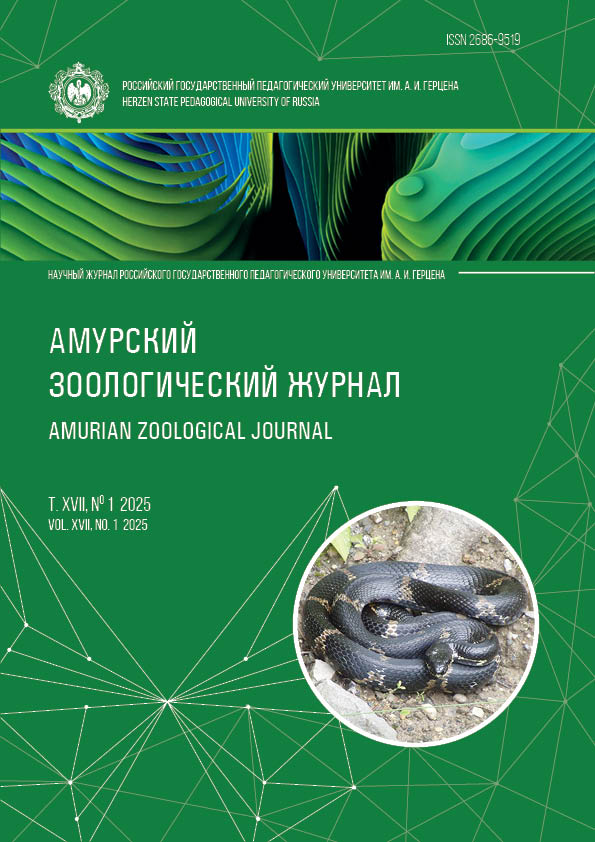
Hebius vibakari (Boie, 1826) is a poorly studied snake species native to the Russian Far East. In early August 2024, an adult specimen of this elusive species was found and photographed by the present author in the Studenaya River valley, near the village of Dukhovskoe. The snake was found hiding beneath a flat stone on the river bank. This report is the first confirmed record of the Japanese keelback from Pogranichny District, which contributes to our understanding of Hebius vibakari distribution in Primorsky Krai.
References
Adnagulov, E. V. (2020) Osobennosti rasprostraneniya yaponskogo uzha Hebius vibakari (H. Boie, 1826) (Colubridae: Natricinae) v rossijskoj chasti areala [The distribution of Hebius vibakari (H. Boie, 1826) (Colubridae: Natricinae) in its Russian range]. Amurskij zoologicheskij zhurnal — Amurian Zoological Journal, vol. 12, no. 4, pp. 524–539. https://doi.org/10.33910/2686-9519-2020-12-4-524-539 (In Russian)
Dunaev, E. A., Orlova, V. F. (2017) Zemnovodnye i presmykayushchiesya Rossii: atlas-opredelitel’ [Amphibians and reptiles of Russia: Key atlas]. 2nd ed. Moscow: Fiton XXI Publ., 328 p. (In Russian)
Emelianov, A. A. (1929) Zmei Dal’nego Vostoka [Snakes of the Far Eastern District]. Vladivostok: Vladivostok Branch of the State Russian Geographical Society Publ., 208 p. (Zapiski Vladivostokskogo otdeleniya gosudarstvennogo Russkogo geograficheskogo obshchestva (Obshchestva izucheniya Amurskogo kraya) [Notes from the Vladivostok Department of the State Russian Geographical Society (Society for the study of the Amur Region)]. Vol. 3 (20). Iss. 1). (In Russian)
Gao, Z.-Y., Huang, J.-J., Ding, L. et al. (2024) Taxonomic re-evaluation of the subspecies of Hebius vibakari (Boie, 1826) (Reptilia: Serpentes: Natricidae), with new evidence from central and northern China. Zootaxa, vol. 5474, no. 5, pp. 503–521. https://doi.org/10.11646/zootaxa.5474.5.3 (In English)
Kharin, V. E. (2011) Annotirovannyj katalog amfibij i reptilij (Amphibia, Reptilia) Dal’nevostochnogo morskogo biosfernogo zapovednika [Annotated catalogue of amphibians and reptiles (Amphibia, Reptilia) of the Far-Eastern Marine Biosphere Reserve FEB RAS]. Biota i sreda zapovednikov Dal’nego Vostoka — Biodiversity and Environment of Far East Reserves, no. 1, pp. 30–48. (In Russian)
Korotkov, Yu. M. (1985) Nazemnye presmykayushchiesya Dal’nego Vostoka SSSR [Terrestrial reptiles of the Far East of the USSR]. Vladivostok: “Dal’nevostochnoe knizhnoe izdatel’stvo” Publ., 136 p. (In Russian)
Maslova, I. V., Portnyagina, E. Yu., Sokolova, D. A. et al. (2018) O rasprostranenii redkikh i ischezayushchikh amfibij i reptilij Primorskogo kraya (Dal’nij Vostok, Rossiya) [Distribution of rare and endangered amphibians and reptiles in Primorsky Krai (Far East, Russia)]. Nature Conservation Research. Zapovednaya nauka — Nature Conservation Research, vol. 3, suppl. 1, pp. 61–72. https://doi.org/10.24189/ncr.2018.052 (In English)
Zhao, E. M., Zhao, H., Zhou, Z. Y. (2004) Herpetodiversity of northeastern China and their distribution. Sichuan Journal of Zoology, vol. 23, no. 3, pp. 165−168. (In Chinese)
Zhao, W. G. (2008) The amphibia and reptilia fauna of Heilongjiang, China. Beijing: Science Press, 249 p. (In Chinese)
Downloads
Published
Issue
Section
License
Copyright (c) 2025 Nikita E. Pokhilyuk

This work is licensed under a Creative Commons Attribution-NonCommercial 4.0 International License.
The work is provided under the terms of the Public Offer and of Creative Commons public license Creative Commons Attribution 4.0 International (CC BY 4.0).
This license permits an unlimited number of users to copy and redistribute the material in any medium or format, and to remix, transform, and build upon the material for any purpose, including commercial use.
This license retains copyright for the authors but allows others to freely distribute, use, and adapt the work, on the mandatory condition that appropriate credit is given. Users must provide a correct link to the original publication in our journal, cite the authors' names, and indicate if any changes were made.
Copyright remains with the authors. The CC BY 4.0 license does not transfer rights to third parties but rather grants users prior permission for use, provided the attribution condition is met. Any use of the work will be governed by the terms of this license.